Welcome to the Höhfeld group
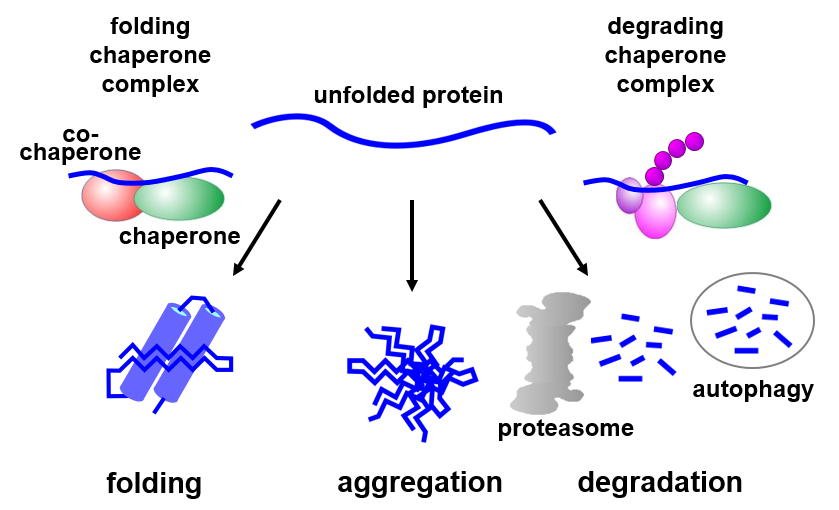
Proteins are essential components of living cells. They perform their functions based on a specific three-dimensional structure. If a protein is misfolded, however, this leads to a loss of protein function and can ultimately even cause the cell to die. In fact, in human diseases such as Alzheimer’s or Parkinson’s, misfolded proteins clump together in the brain. This highlights how important it is to maintain the structure of proteins in our bodies and to prevent the accumulation of misfolded proteins. To achieve this, proteins in the cell are subject to constant quality control. In this process, misfolded proteins are recognized by molecular chaperones and subsequently either folded into their correct shape or directed to the cellular waste disposal system for degradation. In our research, we investigate the cellular mechanisms involved in quality control. In addition to biochemical and cell biological experiments, we also use model organisms such as the fruit fly and the mouse. This allows us to identify which developmental processes and organ systems are most heavily dependent on quality control. In the long term, this research could form the basis for the development of new therapeutic approaches to treat protein aggregation diseases such as Alzheimer’s, cystic fibrosis, or certain muscle disorders.
Since 2018, the working group has led the DFG-funded research group FOR 2743, which investigates the molecular mechanisms underlying proteome maintenance under mechanical stress.
Contact

Prof. Dr. Jörg Höhfeld
Ulrich-Haberland-Str. 61a
53121 Bonn