
Universität Bonn

Bonner Institut für organismische Biologie

Bee hotels as a model system for field ecology and insect interactions (OEP-B31)

Trap nests for wild bees and other hymenopterans (so-called wild bee hotels) are excellent tools for studying the impact of environmental factors on species communities.

In our class “Bee hotels as model systems for field ecology and insect interactions” students investigate the communities of these trap nests at five locations in Bonn along an urban-rural gradient.

The role of trap nest inhabitants as bioindicators for habitat quality is derived, among other things, from the species composition of the inhabitants and their food sources, as well as gender composition, parasitism rates and unknown mortality and the diversity of species traits such as nest-building material.
Read more on the five localities and ongoing student research below.

Back to Overview Teaching BIOB I (Botany)
Back to Overview Teaching BIOB III (Evolutionary Biology and Ecology)
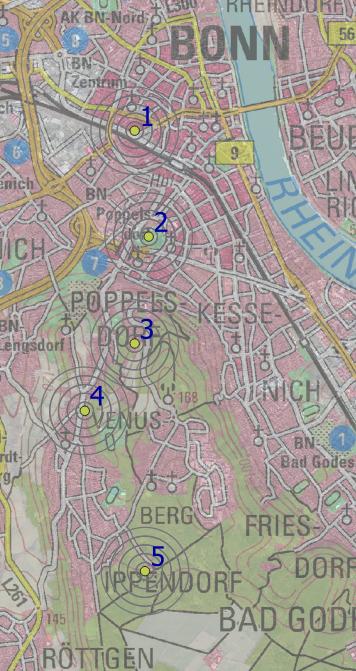
B31 Study sites
B31 Study sites © Jens Mukte / Uni Bonn; Background map (c) OpenStreetMap contributors

Locations & Ongoing Student Research

Group 1: Here comes your image
© Hannah Otto / Universität Bonn

Old Cementery Bonn

Between buildings and streets the Old Cemetery offers a peaceful, semi-
natural refuge. Towering trees and dense hedges cover a wildflower meadow, alive with birdsong and darting squirrels. But what about solitary wild bees and wasps? Join us in uncovering whether the Old Cemetery harbours a hidden diversity of wild bees. Or is it as lifeless as the word “cemetery” suggests? 
Group 2: Placeholder - will be replaced
© Marlon Martin / Universität Bonn

Botanical Gardens Bonn (Schlossgarten)

Located just a short distance from Bonn's city center, the Botanical Garden spans 12 hectares in three locations and hosts around 11,000 plant species. The largest part is the Schlossgarten with approximately 6 hectares surrounding the Poppelsdorf Palace. The  rich biodiversity makes it an ideal setting for studying insect and pollinator diversity. With such plant diversity, one might expect a thriving hotspot for pollinators—but is this really the case?

Collage Moos (Detail) und Moose im Lebensraum Wald
© Leonie Keilholz / Universität Bonn

Melbgarden (part of the Botanical Gardens Bonn)

Hidden in the Melb Valley, the Melbgarden (part of the Bonn Botanical Gardens) is home to many exotic plants. Located between the city center and rural areas, it provides a promising study site for wild bees. By peeking inside the bee hotels (trap nests), we discovered not only different bee and wasp species but also their natural antagonists and their eating habits. Curious? Explore the life of Melbgarden!


Präparation und mikroskopische Bilder von Pflanzendetails
© Lennard Jacobs / Universität Bonn

Ippendorf Cementery

At the outskirts of Bonn lies the cemetery of Ippendorf. The area around it offers a combination of natural and urban habitats for insect inhabitants. Many different cavity-nesting wild bee and wasp species can be found here. A hidden but complex network of food sources and parasites exists around these species. Bees feed pollen of trees and other plants to their larvae while parasites try to get their share.

Präparation und mikroskopische Bilder von Pflanzendetails
© Annika Steinert / Universität Bonn

Waldau - near 'Haus der Natur'

Away from the city’s bustle, the bee hotel (trap nest) in Waldau is surrounded by an orchard and forest next to the House of Nature. Extensive meadows and mature trees appear to offer ideal habitats for wild bees and wasps. Yet beneath the canopy, a more complex picture emerges. Our research examines, whether Waldau really functions as a refuge for wild bees.


Wird geladen