
Dr. Gustavo Ramos
Akademischer Rat a.Z.
AG Biodiversität der Pflanzen
Forschung
Integrative phylogenomics, taxonomy, morphology, ecology, biogeography
Forschungsprofil
I am a tropical botanist from Brazil, and my research focuses on integrative approaches to understanding the evolutionary history of flowering plants. My work encompasses taxonomy, phylogenetics (including omics), biogeography, and morphology.
In Weigend’s Working Group, I investigate biomineralization processes in plant organs such as trichomes, stems, leaves, flowers, and fruits. By combining Scanning Electron Microscopy (SEM) with Energy-dispersive X-ray Spectroscopy (EDX), the differential deposition of minerals across distinct plant tissues can be detected allowing us to discuss the adaptive value of such processes. Part of this research also involves using micro-computed tomography (µ-CT) to analyze 3D imagery of plant organs leading to in depth studies such as flower development. With the integration of morphological data with modern sequencing technologies, such as the Angiosperms353 probe set, we aim to shed light on the adaptive relevance of plant functional traits.
I am also interested in flower evolution from a genetic perspective. I compare sister species with contrasting morphological features to identify the genes involved in establishing such divergences. To do this, I employ whole genome sequencing (WGS) and a candidate gene approach to mine for floral genes.
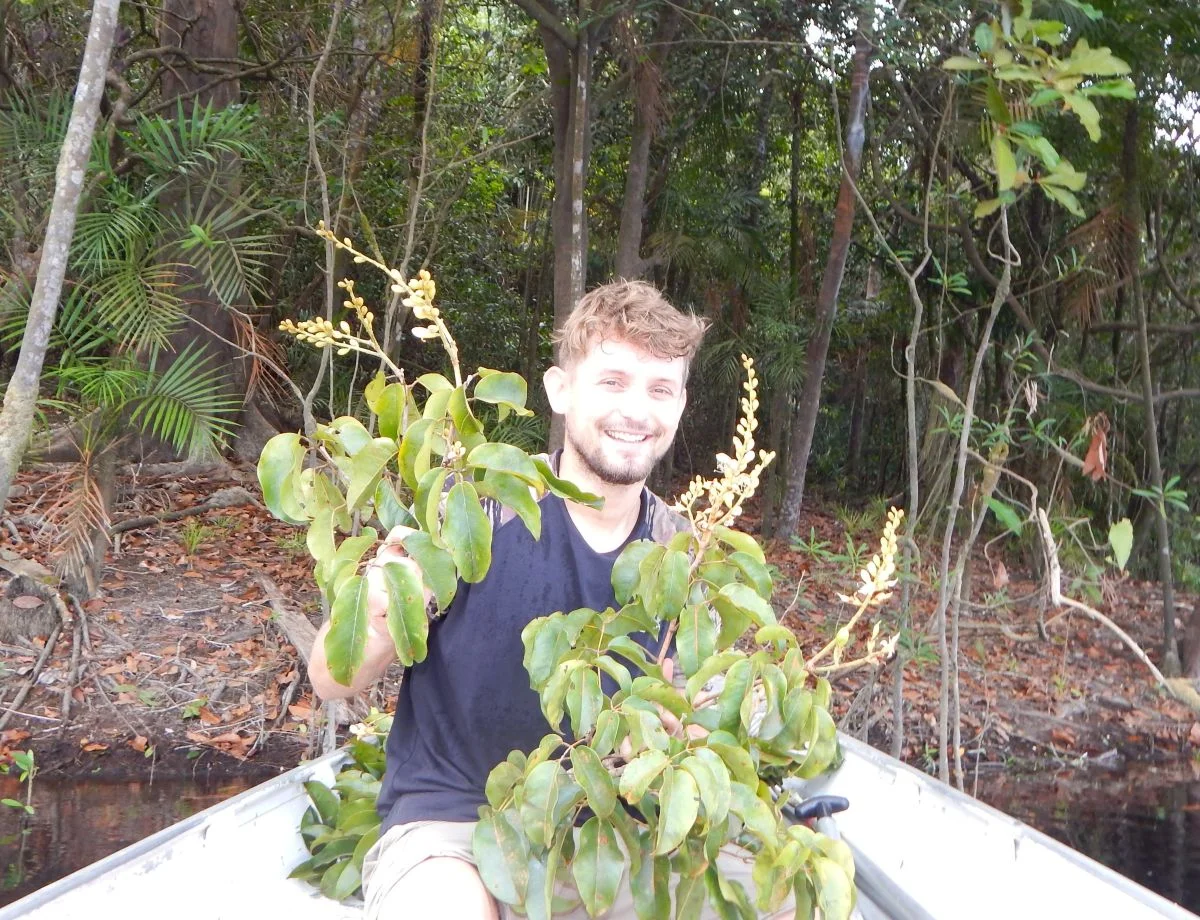
Additionally, I am interested in taxonomy and biogeography, with a focus on species from remote, underexplored regions such as the Amazon rainforest and the Andira clade (Aldina + Andira + Hymenolobium) of papilionoid legumes (Leguminosae).

Dr. Gustavo Ramos
2.005
Meckenheimer Allee 170
53115 Bonn
Lebenslauf
2026 – present - Postdoc at Bonner Institut für organismische Biologie – Abteilung Biodiversität der Pflanzen (ehemals Nees-Institut)
2025 – 2026 - Postdoc at Universität Leipzig: Plants and Politics working group. Germany.
2024 – 2025 - Research Fellow at Royal Botanic Garden Edinburgh: SIBBALD Fellowship at the department of Taxonomy and macro-ecology. Scotland.
2019 – 2025 - PhD at University of Edinburgh/Royal Botanic Garden Edinburgh. Thesis title: The evolution of the legume flower: case studies in the early-branching papilionoid legumes (Papilionoideae, Leguminosae).
2016 – 2018 – M.Sc. studies in Botany at Universidade Estadual de Feira de Santana. Thesis title: Taxonomy of the species of the Amazonian genus Aldina Endl. in Brazil.
2009 – 2016 – B.Sc. in Biological Sciences at Universidade Federal da Bahia, Salvador.
Ramos G (2024). Floral evolution of morphologically unusual papilionoid legumes (Leguminosae, Papilionoideae). XX International Botanical Congress. Madrid, Spain. (oral presentation).
Ramos G (2023). The evolution of the pea flower: case studies in the early-branching lineages of papilionoid legumes. 8th International Legume Conference. Pirenopolis, Goias, Brazil. (oral presentation).
Ramos G (2022). The evolution of the pea flower: case studies in the early-branching lineages of papilionoid legumes. Institute of Molecular Plant Sciences, University of Edinburgh, United Kingdom (poster presentation).
Ramos G (2015). Molecular systematics of Aldina, a phylogenetically enigmatic Amazonian genus of Papilionoid legumes. Legume Morphology International Symposium and Workshop: current knowledge and future directions. Botucatu, Sao Paulo, Brazil. (oral presentation).
Ramos G (2015). Molecular systematics of Aldina, a phylogenetically enigmatic Amazonian genus of Papilionoid legumes. 66 National Botany Congress. Santos, Sao Paulo, Brazil. (oral presentation).
Lehre
Aktuelle Lehre
- WBIO-C13 Mikroskopie und funktionelle Morphologie in der Botanik
(BSc Biologie)
Forschungsthemen

Integrative phylogenomics, taxonomy and morphology
My research is based on the integration of complementary subjects to investigate evolutionary processes in flowering plants. By combining molecular and morphological data I test the phylogenetic and taxonomic hypotheses on species relatedness, geographical distribution, and analyze patterns of morphological evolution.
Ausgewählte Publikationen
-
Ramos, G., G. Prenner, S.P. Teixeira, B.B. Klitgaard, R.T. Pennington, C. Kidner, D. Cardoso. 2026. Evolution of androecium symmetry and petal heterochrony across the florally diverse papilionoid legumes. Submitted to Annals of Botany.
-
Gregorio, B.S., C.S. Carvalho, C.H. Stirton, G.P. Lewis, B.M. Torke, G. Ramos, L. Rocha, C.E. Zartman, D. Cardoso. 2025. Phylogenomics, morphological evolution, and taxonomic revision of Spirotropis, a newly delimited legume genus of ecologically dominant Amazonian tree species. Taxon, v. 00, p.1–30.
-
Gregorio, B.S., C.S. Carvalho, G. Ramos, L. Rocha, H.C. de Lima, C.E. Zartman, G.P. Lewis, B.M. Torke, C. Snak, H.A.D Higuita, L.P. de Queiroz, D. Cardoso. 2024. A molecular phylogeny of the early-branching Genistoid lineages of papilionoid legumes reveals a new Amazonian genus segregated from Clathrotropis. Botanical Journal of the Linnean Society, v. 205, p.1–14.
-
Azani, N., M.B. Babineau, C. Bailey…G. Ramos. 2017. A new subfamily classification of the Leguminosae base on taxonomically comprehensive phylogeny – The Legume Phylogeny Working Group (LPWG). TAXON, v.6, p.44–77.
-
Ramos, G., H.C. de Lima, G. Prenner, L.P. de Queiroz, C.E. Zartman, D. Cardoso. 2016. Molecular systematics of the Amazonian genus Aldina, a phylogenetically enigmatic ectomycorrhizal lineage of papilionoid legumes. Molecular Phylogenetics and Evolution, v. 97, p. 11–18.
Taxonomy
Contributing to fill in the gaps on species’ biodiversity knowledge is immensely rewarding and this can be achieved in many ways, such as by providing checklists of your local flora, revising herbarium collections, discovering new species to science, and publishing taxonomic accounts (e.g., notes, synopsis, revisions, monographs). This often involves carrying out fieldwork in stunning localities, visiting herbarium collections, and having exciting discussions to determine taxa’s fates.
Ausgewählte Publikationen:
-
Gregorio, B.S., C.S. Carvalho, G. Ramos, L. Rocha, C.H. Stirton… D. Cardoso. 2024. Taxonomic revision of the Amazonian papilionoid genus Cabari. Systematic Botany, 49:247–269.
-
Ramos, G., C.E. Zartman, H.C. de Lima, R.T. Pennington, D. Cardoso. 2022. A taxonomic synopsis of Aldina, a florally distinctive and poorly collected Amazonian genus of papilionoid legumes. Systematic Botany, v7., p. 962 – 977.
-
Cardoso, D., G. Ramos, W.M.B Sao-Mateus, L.P. de Queiroz. 2019. Aeschynomene chicocesariana, a striking new unifoliolate legume species from the Brazilian Chapada Diamantina and its Phylogenetic placement in the Dalbergioid clade. Systematic Botany, v.44, p. 910–817.
-
Ramos G. & D. Cardoso. 2016. Towards a taxonomic revision of the papilionoid legume genus Aldina: lectotipification of a name published in Flora Brasiliensis. Neodiversity, v.9, p. 1-3.


Ecology and Biogeography
Plant species offer excellent models to understand how the biotic and abiotic spheres shape the distribution of species and the underlying evolutionary processes therein. By observing current ecological preferences, we are able to predict and look into the past, present and future of species distribution. This is a valuable mean to understand evolutionary processes underlying species diversification and towards decision-making in environment conservation.
Ausgewählte Publikationen
-
Cardoso, D., P. Moonlight, G. Ramos, G. Oatley, C. Dudley, E. Gagnon, L.P. de Queiroz, R.T. Pennington, T.E. Sarkinen. 2021. Defining biologically meaningful biomes through floristic, functional, and phylogenetic data. Frontiers in Ecology and Evolution, v.9, p. 1–16.
Moonlight, P., P.L.S. Miranda, D. Cardoso, K.G. Dexter, R.T. Pennington, G. Ramos, T.E. Sarkinen. 2020. The strengths and weakness of species distribution models in biome delimitation. Global Ecology and Biogeography, v. x, p. gen.13149-15.